Are Dads the new Moms? The New American Parents
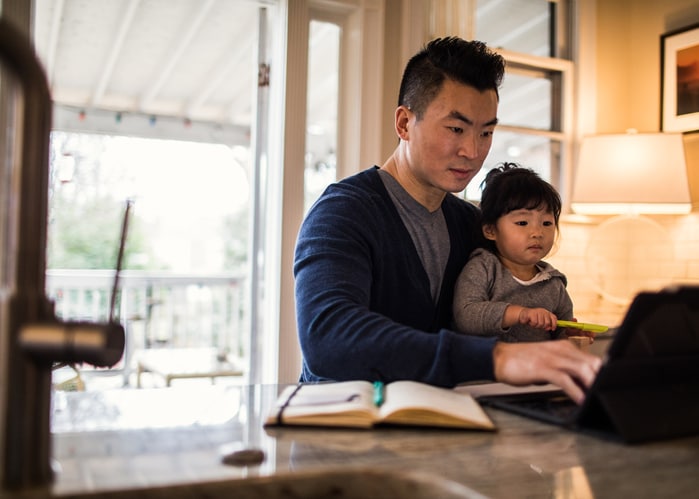
My husband, Ron, really enjoys coaching our little guy's baseball, football, and soccer teams, and lately, he's noticed more stay-at-home and work-at-home dads on the sidelines after school.
And, at work, I also seem to notice an increasing number of moms going back to work full-time while their husbands stay at home with the kids. It's fantastic that so many families are figuring out flexible ways to juggle "being the breadwinner" and caring for their loved ones.
According to a recent article on the parenting community Babble.com, there has been a 62% rise in single father households from 1990 to 2003, and the number of stay-at-home dads in the U.S. last year had risen to 159,000 (2.7% of the country's total number of stay-at-home parents), according to an article by the Washington Post.
Both media outlets point out, however, that these statistics ignore the number of work-from-home parents, or parents working part-time, contributing to the ever-changing dynamics of this new style of American parenting.
Two dads who took note of this changing parenting landscape, where families strive for balance, flexibility, and pragmatism over traditional gender roles, were Tom Perrotta, author of the best-selling novel Little Children (as well as the film adaptation
starring Kate Winslet, Patrick Wilson, and Jennifer Connelly), which features a stay-at-home dad as a central character, and Dana Glazer, a filmmaker currently producing a documentary called The Evolution of Dad, following the history of fatherhood and gender equality in parenting from the 1950s to the present.
So, what does this new dad look like? And, is he really taking on the traditional "mommy" role?
"Todd [the stay-at-home dad in Little Children
] was a sort of idealized figure, almost the embodiment of the fantasies of the stay-at-home moms at the playground," Tom Perrotta said. "I wanted him to be a nurturing father who was completely masculine…He's a new figure, but not yet an archetype, because the role is still in process. We haven't really figured out what to make of stay-at-home dads yet."
And Dana Glazer agreed, that stay-at-home dads are just a tiny fraction and sub-culture representing what is a much more radical change in the way families are operating these days and handling their approach to child care and childrearing.
"Stay at home dads, at least from my perspective, are a total novelty and something that’s been going on since the early 90s," Dana said. "Typically the stories are fluffy: they claim that [stay-at-home dads] are growing in numbers; and then there's a citation from the Census Bureau; and then there's always the references to the movies Mr. Mom
or Daddy Day Care
. My perspective on [this trend] is that on the surface, it's progressive, but underneath that, it's the status quo—just a flip in the traditional gender role. You get traditional dads who glance at it and go "ICK!" And you get feminists that say, "Yes! That's it. That's great." But the larger issues at hand, like gender equity and work-family balance, are largely ignored. I think the world is better off not just with one parent at home, but for the kids to get to know both parents. In the best possible world, you have the kids interacting with both parents as much as possible. What my kids get from my wife is very different from what they get from me, and kids are so stimulated by that different kind of interaction. The more the typical gender roles blend, the better. And I think that is happening, but it’s still pretty traditional overall. The stay-at-home dad phenomenon is great, but it tends to overshadow the real progress."
Both men have been work-at-home dads for the majority of their kids' lives, and they both had some pretty strong opinions on why this changing parenting dynamic has come about—and the challenges it also presents both for companies and for couples.
"The obvious answer is feminism—when a woman has a high-paying, rewarding career, why should she have to give up her job to care for the kids?" Tom said. "Why can't the father do the child care, especially if his job isn't so rewarding or lucrative? More and more couples are finding themselves in an economic situation where it seems like the most sensible thing is for the mother to keep working and the father to take over the home front."
But it's not quite as simple as that, as Dana pointed out.
"Women can be territorial around the maternal ground and just push the dads back off to work," Dana said. "A lot of divorces happen because of it, and it's important for couples to really talk about it before the kid is born. What's going to happen? Who's going to do what? And if you don't talk about it, everyone just falls back into those traditional roles. Women are getting the message, "You can do anything! You can do it all!" And if you don't talk about it, a lot of guilt and resentment can come into play. The big picture is how you get all these parts working together, and it's not easy. It takes a lot of discipline to do these things…Fatherhood is really important and we're really making strides, but you start to see that things really haven't progressed as much as we'd like to think we have."
Are you a work-at-home or stay-at-home dad, or do you have a spouse who is? We'd love to hear from you! Share your experiences with the Care.com community by posting a comment below.


Subscribe to Sheila's Blog